

If you are thinking about becoming an interior designer or you are already working in the field and wondering whether you are being paid fairly, you have come to the right place. Interior designer salary data can be confusing. One source says the average is $63,000. Another says $92,000. A third says $78,000. Who is right? The answer depends on which data source you read, what experience level they measured, and whether bonuses are included.
This guide cuts through the noise. You will get real numbers, clear explanations, and practical advice based on how interior design pay actually works in 2026.
Quick Answer: What Is the Average Interior Designer Salary in 2026?
The median annual salary for interior designers in the United States is $63,490, according to the U.S. Bureau of Labor Statistics (BLS) using May 2024 data. That works out to roughly $30.52 per hour.
But that number is just the midpoint. The full salary range is wide:
| Percentile | Annual Salary |
|---|---|
| 10th (lowest earners) | $38,480 |
| 25th | $48,000 |
| 50th (median) | $63,490 |
| 75th | $85,500 |
| 90th (top earners) | $106,090+ |
Other platforms report higher averages because they measure different things. Here is a quick breakdown so you know which number to trust for what purpose:
| Source | Figure | Methodology | Best Used For |
|---|---|---|---|
| BLS | $63,490 median | Employer-reported survey data | Most accurate national benchmark |
| Salary.com | $61,012 | Job posting + compensation surveys | Percentile benchmarking |
| Indeed | $78,046 | Active job posting data | Current job market rates |
| ZipRecruiter | $72,849 | Job postings + ZipEstimate algorithm | Salary range exploration |
| Glassdoor | $76,659 base / $92,073 total | Employee self-reported + employer data | Total compensation including bonuses |
| ASID (2026Report) | $71,430 | Industry member survey | Professional association benchmark |
Why Salary Figures Vary So Widely Across Sources
This is the question almost every competitor skips, but it matters a lot.
The BLS collects data directly from employers through a mandatory government survey. It does not include self-employed designers, which pulls the median down. Glassdoor and Indeed pull from job postings and employee-submitted reports, which skew toward full-time employed professionals at larger firms, where pay is higher.
Neither number is wrong. They just measure different slices of the profession. When you see a salary figure, always check the source before using it to negotiate your pay.
The most reliable benchmark for most situations: Use BLS as your floor and Glassdoor total compensation as your ceiling. Your actual salary will likely fall somewhere in between, shaped by your location, experience, and specialization.
Interior Designer Salary Range: The Full Picture
Before you look at your own situation, it helps to understand the full salary landscape.
The spread between the lowest and highest earners in interior design is dramatic. A junior designer in a small market might earn $38,000. An established senior designer in New York City working on luxury hospitality projects can pull in $150,000 or more, including bonuses and commissions.
That threefold difference is not random. It reflects experience, location, specialization, firm size, and certifications. Each of those factors is something you can actually influence.
What Interior Designers Earn Per Hour
If you work hourly as a freelancer, or you are comparing job offers that list hourly rates, here is what the numbers look like in practice:
| Experience Level | Estimated Hourly Rate |
|---|---|
| Entry-level | $18 to $26/hr |
| Mid-level | $31 to $41/hr |
| Senior | $43 to $55/hr |
| Director level | $54 to $80+/hr |
Freelancers often charge higher hourly rates than these figures suggest, because they need to cover self-employment taxes, insurance, software subscriptions, and unbillable admin time. A freelancer charging $75 per hour is not necessarily out-earning an employed designer making $65,000 per year once overhead costs are factored in.
How Interior Designer Pay Has Changed from 2018 to 2026
Salary growth in interior design has been steady but not dramatic. The median wage has increased roughly 11 to 14 percent over the past seven years, which roughly tracks with inflation. Where things have changed more significantly is at the top end of the market, where senior and director-level designers in high-demand cities have seen faster wage growth, particularly in technology campus design, healthcare, and luxury hospitality.
The ASID 2026 State of Interior Design Report shows a 2.1 percent increase from 2023 to 2024, reaching an average of $71,430 among its member designers. That modest growth reflects both the profession’s stability and the broader economic slowdown in commercial real estate.
Interior Designer Salary by Experience Level
Experience is the single biggest driver of pay in this profession. Where you sit on the career ladder matters more than almost any other factor in the early years.
Entry-Level Interior Designer Salary (0 to 2 Years)
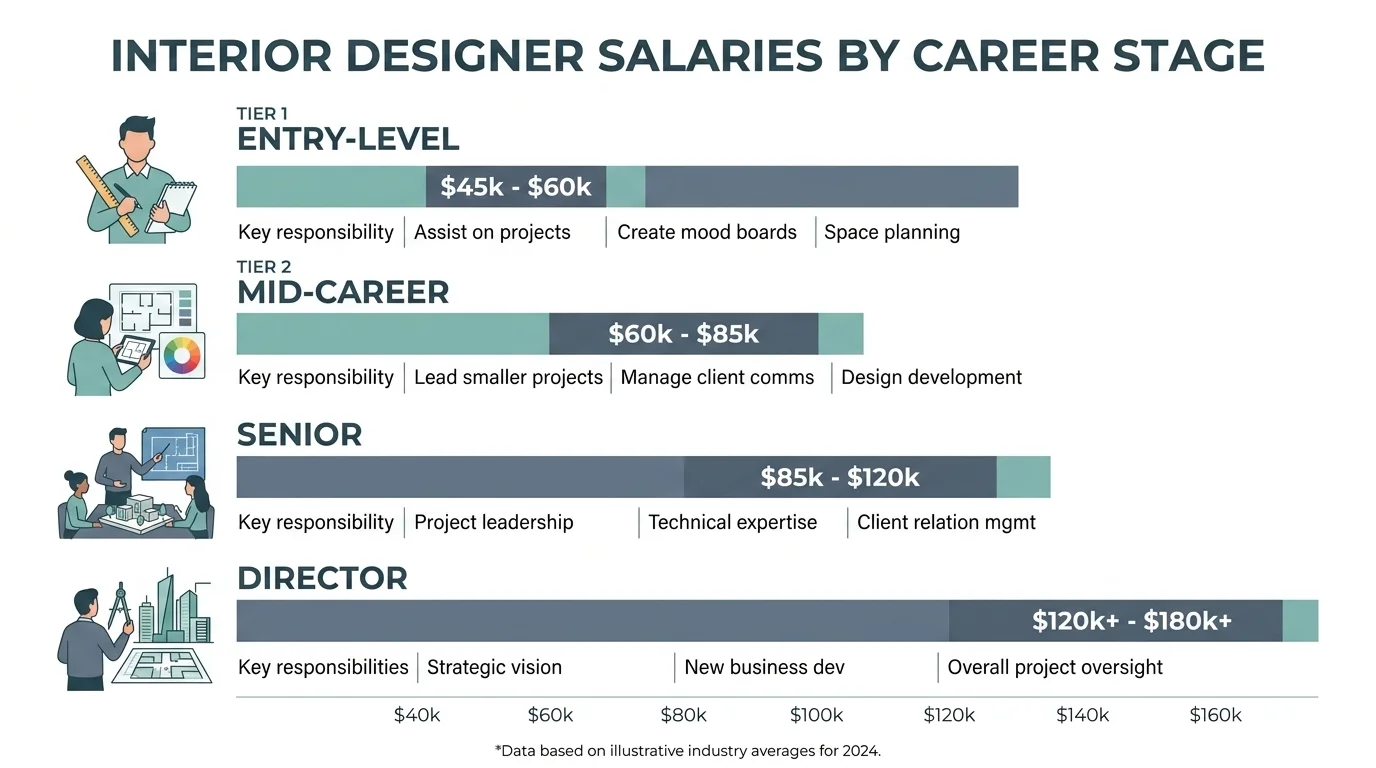
Most designers starting out earn between $40,000 and $55,000 per year, depending on location and employer. PayScale puts the figure at $46,600 for those with less than one year of experience. Glassdoor shows entry-level ranges starting as low as $33,269 in some markets and reaching $67,928 in competitive cities.
At this stage, your job typically involves supporting senior designers with material sourcing, preparing design boards, drafting in CAD, and handling vendor coordination. You are building skills and a portfolio, not commanding top dollar. That is completely normal.
What separates the higher-earning entry-level designers from the lower-earning ones is usually one of three things: a strong internship at a recognized firm, proficiency in at least one industry software tool beyond AutoCAD, or a location in a high-demand market.
Mid-Level Interior Designer Salary (3 to 7 Years)
This is where salary growth accelerates. Mid-career designers typically earn between $65,000 and $85,000 per year. By this point, you are managing projects independently, working directly with clients, and starting to develop a recognizable design perspective.
Many designers in this bracket begin choosing a specialization, whether that is commercial office, healthcare, retail, or high-end residential. That decision often determines whether they trend toward the lower or higher end of their next salary bracket.
Senior Interior Designer Salary (8 to 10+ Years)
Senior designers and lead designers typically earn $90,000 to $120,000 annually. In major markets like New York, San Francisco, or Los Angeles, experienced senior designers at established firms can earn considerably more, especially when bonuses and profit sharing are included.
At this level, you are not just designing. You are managing client relationships, directing junior staff, presenting to stakeholders, and often contributing to business development. The salary reflects those expanded responsibilities.
Salary.com breaks down the senior tier further:
| Role | Average Annual Salary |
|---|---|
| Interior Designer III | $70,076 |
| Interior Designer IV | $80,860 |
| Interior Designer V | $93,673 |
| Senior Interior Designer | $70,100 to $93,000+ |
| Specialist Interior Designer | $80,900 |
Design Director and Principal Interior Designer Salary
At the top of the ladder, design directors earn an average of $112,909 per year, according to 2026data. Principals and studio directors at established firms can earn $130,000 to $180,000 or more, depending on the size and reputation of the practice.
These roles are less about daily design execution and more about vision, leadership, and business growth. They require a combination of deep design expertise and strong business acumen.
A 10-Year Salary Growth Roadmap
Here is a realistic picture of how salary typically progresses through a full career in interior design:
| Career Stage | Years | Typical Salary Range |
|---|---|---|
| Junior / entry-level | 0 to 2 | $40,000 to $55,000 |
| Early career | 2 to 4 | $50,000 to $65,000 |
| Mid-career | 4 to 7 | $65,000 to $85,000 |
| Senior designer | 7 to 10 | $85,000 to $115,000 |
| Director / principal | 10+ | $112,000 to $180,000+ |
These ranges are national averages. Your actual trajectory depends heavily on where you work and whether you specialize.
Interior Designer Salary by State and City
Location might be the second most important factor after experience. The difference between the lowest-paying and highest-paying states for interior designers is significant.
Top 10 Highest-Paying States for Interior Designers in 2026
Based on BLS and Salary.com data, the states offering the highest interior designer salaries in 2026 include:
| State | Average Annual Salary |
|---|---|
| District of Columbia | $66,343 |
| California | $66,091 |
| Massachusetts | $65,210 |
| Washington | $64,971 |
| New York | $63,700 |
| Oregon | Above national average |
| Colorado | $55,000+ |
| Idaho | Above national average |
| North Dakota | Above national average |
| Utah | Above national average |
California’s strength comes from its dense design market in Los Angeles and San Francisco. The District of Columbia benefits from a constant flow of large-scale government and commercial interior projects. Washington state has seen strong growth in technology campus and corporate office design.
Interior Designer Salary by City: Top 15 Markets
City-level data shows an even wider range than state averages:
| City | Average Salary (Source) |
|---|---|
| New York, NY | $104,454 (Indeed) / $123,000 (Bespoke Careers) |
| San Francisco, CA | $93,085+ (Glassdoor total pay) |
| Los Angeles, CA | Above CA average |
| Chicago, IL | $74,132 (Indeed) |
| Denver, CO | $73,836 (Indeed) |
| Phoenix, AZ | $77,166 (Indeed) |
| Oklahoma City, OK | $67,708 (ZipRecruiter) |
| Atlanta, GA | Competitive with lower COL |
| Dallas, TX | Competitive with lower COL |
| Boston, MA | $65,000+ |
| Seattle, WA | $64,971+ |
| Washington, D.C. | $66,343+ |
| Miami, FL | Below national average |
| Austin, TX | Growing market |
| San Jose, CA | $67,912 (Salary.com) |
Salary vs. Cost of Living: Which Cities Offer Real Earning Power?
This is the analysis almost no competitor runs, and it is one of the most useful ways to evaluate a job offer or a relocation.
A $104,000 salary in New York City is not the same as a $75,000 salary in Dallas when you factor in rent, taxes, and the cost of everyday life. When you adjust interior designer salaries for local cost of living, the rankings shift significantly.
Consider this:
- New York City: High salary, very high cost of living. Purchasing power often lower than expected.
- Dallas, TX: Moderate salary, low cost of living, no state income tax. Real purchasing power among the best in the country.
- Atlanta, GA: Similar dynamic to Dallas. Salaries are lower on paper but go further in practice.
- San Francisco, CA: Often the highest salaries, but housing costs are so extreme that effective purchasing power can be lower than mid-tier cities.
If you are considering a move to chase a higher salary, run the math first. A $10,000 nominal raise that comes with a $20,000 increase in annual living costs is actually a pay cut.
The NYC vs. Dallas vs. Atlanta Comparison
A mid-level designer earning $85,000 in New York City, $72,000 in Dallas, and $68,000 in Atlanta is actually living on very similar real incomes once cost of living is applied. In some calculations, the Dallas and Atlanta designers come out ahead in actual purchasing power.
This does not mean New York is a bad market. The career exposure, client diversity, and professional network access in NYC are genuinely worth something. But salary alone does not tell the full story.
Interior Designer Salary by Specialization
Not all interior designers do the same work, and the pay reflects that difference clearly.
Residential Interior Designer Salary
Residential designers earn an average of $54,098 per year according to Salary.com, which is roughly 10 to 15 percent below the overall national median. This is partly because residential projects tend to be smaller in scale, have lower fee potential, and involve clients with tighter budgets than commercial work.
ZipRecruiter shows a higher figure of around $72,849, which likely captures successful independent residential designers who have built strong client rosters and charge premium fees.
The gap between residential and commercial pay is not inevitable. High-end residential designers working with affluent clients in major cities can earn well above six figures. The key is the client tier, not the sector itself.
Commercial Interior Designer Salary
Commercial designers, particularly those working in architectural and engineering services firms, earn a median of $75,850 per year (BLS). This is roughly $12,000 more than the overall median, reflecting the complexity, scale, and technical requirements of commercial projects.
Office design, corporate campuses, retail environments, and mixed-use developments all fall under this umbrella. Working for a large firm like Gensler, which handles some of the world’s largest office and hospitality projects, typically puts designers at the higher end of the commercial pay scale.
Luxury Interior Designer Salary
Luxury designers operating at the top of the market can earn anywhere from $100,000 to $250,000 or more, especially if they run their own practice. The key differentiator is client access. Designers working with high-net-worth individuals, luxury hotel brands, or premium real estate developers operate at a completely different fee structure.
Many luxury designers charge flat project fees rather than hourly rates, and those fees on a single project can exceed what a residential designer earns in a full year.
Healthcare and Hospitality Interior Designer Salary
Healthcare design is one of the most specialized and consistently well-paid niches in the profession. Designing hospitals, clinics, assisted living facilities, and medical offices requires knowledge of building codes, infection control, accessibility standards, and patient psychology that most generalists do not have.
That expertise commands a 20 to 40 percent premium over generalist rates, according to industry data. Hospitality design, particularly luxury hotel and resort projects, also commands strong fees, especially for designers with an established portfolio in that sector.
Sustainable and LEED-Certified Design: The Salary Premium
LEED certification adds an average of 21.71 percent above the standard interior designer salary, according to NEIT research. As corporations face growing pressure to meet environmental, social, and governance (ESG) commitments, the demand for designers who understand sustainable materials, energy efficiency, and green building standards is rising steadily.
WELL AP certification, which focuses on building design for human health and wellness, is a newer credential that is gaining traction, particularly in corporate office and healthcare design. Designers with WELL AP credentials are positioning themselves at the front of a growing wave of demand.
Specialization Salary Comparison
| Specialization | Average Salary | Premium Over Generalist |
|---|---|---|
| Healthcare design | $80,000 to $100,000+ | 20 to 40% |
| Hospitality design | $75,000 to $95,000+ | 15 to 30% |
| Commercial / corporate | $75,850 (BLS median) | ~20% |
| Sustainable / LEED | +21.71% above average | 22% |
| Luxury residential | $80,000 to $250,000+ | Varies |
| General residential | $54,098 | Below average |
Freelance Interior Designer Salary vs. Employed: A Real Comparison
About 20 to 30 percent of interior designers work as freelancers or run their own independent practices. The income range for this group is enormous, from $30,000 in the early years to $250,000 or more for established designers with strong client rosters.

How Much Do Freelance Interior Designers Actually Earn?
The honest answer is: it depends almost entirely on how well you run your business. In the first two to three years of freelancing, most designers earn less than they would in employment. The business development takes time, referrals take time to build, and the administrative overhead of running a practice can eat into billable hours significantly.
The breakeven point, where freelance income consistently exceeds what you would earn employed, typically comes around years five to six, according to industry analysis. After year seven, successful freelancers who have built a strong practice regularly out-earn their employed counterparts by 30 to 100 percent.
Freelance Pricing Models: Hourly, Flat Fee, and Retainers
This is something most salary articles never explain, but it matters enormously for freelance income potential.
Hourly billing: Simple but often undervalues your work. Experienced freelancers typically charge $75 to $200 per hour depending on market and specialization.
Flat project fee: You charge a fixed amount for the full scope of a project. This rewards efficiency. If you can complete a project faster than estimated, your effective hourly rate goes up.
Retainer model: A client pays a monthly fee for ongoing design services. This creates predictable income, which is the holy grail for freelancers. Interior designers who build retainer relationships with property developers, hotel brands, or corporate clients can stabilize their cash flow significantly.
FF&E markup: Many designers add a markup of 15 to 35 percent on furniture, fixtures, and equipment they source for clients. This is a genuine revenue stream that employed designers do not have access to, and it can meaningfully increase total income on large residential or commercial projects.
Large Firm vs. Small Firm vs. Self-Employed
Where you work affects more than just your salary. Glassdoor data shows that larger companies pay interior designers approximately 35 percent more than smaller firms on average. But smaller firms often offer faster advancement, broader project variety, and more client-facing responsibility early in your career.
Hidden Compensation: What You Earn Beyond Your Base Salary
The average interior designer earns an additional $15,252 per year through bonuses, profit sharing, and commissions, according to Glassdoor data. That is not a trivial amount. It represents roughly 20 to 25 percent of the base salary for many mid-career designers.
When evaluating a job offer, always ask about:
- Annual performance bonus structure
- Profit sharing participation
- Commission on new client referrals
- Professional development budget
- Health insurance contribution value
- Retirement plan matching
A job paying $68,000 with a solid bonus structure, full health coverage, and retirement matching can be worth more than a $75,000 offer with no benefits.
How Education and Certifications Affect Interior Designer Salary
Education matters in interior design, but not always in the way you might expect. The credential that has the clearest, most quantifiable salary impact is not a degree. It is professional certification.
NCIDQ Certification: Is It Worth the Investment?
The National Council for Interior Design Qualification (NCIDQ) certification is the most recognized professional credential in the field. Designers with NCIDQ certification earn a median salary roughly $17,000 higher than non-certified designers at a similar experience level, according to NEIT research. That is a 10 to 20 percent premium.
In regulated states, NCIDQ is required for licensure and for certain types of commercial work. Even in states where it is optional, the credential signals professional competence and opens doors to higher-level projects and better-paying employers.
The exam covers seven core competency areas: building systems, construction standards, design application, professional practice, project coordination, codes, and contract administration. It is not easy, but the return on investment is real and measurable.
LEED, WELL AP, and Other Certifications
| Certification | Salary Premium | Best For |
|---|---|---|
| NCIDQ | +10 to 20% ($17,000 median boost) | All commercial work, licensure |
| LEED AP | +21.71% above average | Sustainable design, corporate ESG |
| WELL AP | Emerging premium | Healthcare, corporate wellness |
| CIDA-accredited degree | Higher starting salary | All career paths |
Does a Master’s Degree Increase Your Interior Design Salary?
For most working interior designers, a master’s degree offers a smaller salary return than certification or specialization. The exception is if you are targeting academic positions, large international firms, or leadership roles at architecture-driven practices where advanced credentials are expected.
The better investment for most designers is a CIDA-accredited bachelor’s degree combined with NCIDQ certification and a specialty credential like LEED AP. That combination delivers a higher salary return for a lower time and financial investment than a master’s degree in most cases.
How Software Skills Affect Interior Designer Salary
This is one of the most underreported factors in interior design compensation, and it is becoming more important every year.
Job posting analysis consistently shows that interior designers with proficiency in specific software tools are commanding higher salaries and getting more interview callbacks than generalists.
Top Software Skills That Command a Salary Premium
| Software | Role | Demand Level |
|---|---|---|
| Revit (BIM) | Building Information Modeling | Very high in commercial |
| AutoCAD | Technical drafting | Baseline requirement |
| SketchUp | 3D modeling | High across all sectors |
| V-Ray / Lumion | Photorealistic rendering | High, especially luxury |
| Enscape | Real-time visualization | Growing rapidly |
| Bluebeam | Construction documentation | High in commercial |
BIM-capable designers, particularly those proficient in Revit, are actively sought by architecture and engineering firms, where they command salaries closer to the architectural services median of $75,850 rather than the general interior design median.
3D Visualization and VR: A Growing Salary Premium
Companies are increasingly willing to pay a premium for designers who can produce real-time 3D walkthroughs and virtual reality presentations. Tools like Enscape, Lumion, and Unity allow clients to experience a space before it is built, which accelerates decision-making and reduces costly revisions.
Designers who position themselves as visualization specialists, particularly in high-value sectors like luxury residential and hospitality, can charge significantly higher project fees and attract better-paying clients. This is a skill set that delivers measurable business value to clients, which is exactly the kind of expertise that justifies premium compensation.
Interior Designer Salary vs. Related Professions
If you are deciding between career paths, or just curious how interior design pay stacks up against similar professions, here is how it compares:
| Profession | Median Annual Salary (BLS) |
|---|---|
| Interior Designer | $63,490 |
| Graphic Designer | $59,530 |
| Fashion Designer | $78,980 |
| Landscape Architect | $73,220 |
| Architect | $93,310 |
| Industrial Designer | $77,030 |
| Interior Architect | $85,000 to $115,000+ |
Interior Designer vs. Interior Decorator: What Is the Salary Difference?
This is one of the most searched questions in the space, and the distinction matters.
An interior designer is a trained professional who works with the structure and function of a space, including building codes, space planning, and construction coordination. Many states require licensure for this work.
An interior decorator focuses on the aesthetic layer: furnishings, color, textiles, and accessories. No licensing is typically required.
The salary difference reflects that distinction. Interior decorators generally earn less, often in the $35,000 to $55,000 range, because the scope of their work is narrower. By contrast, professionals who can handle technical design, code compliance, and project management often earn significantly more over the course of their careers.
Interior Designer vs. Interior Architect
Interior architects sit above interior designers in the professional hierarchy in most markets. They have architectural training and can work on structural elements of a space, not just the finishes and furnishings. This broader scope commands a salary premium of 25 to 70 percent depending on role and market.
For designers who want to significantly increase their earning ceiling, pursuing architectural licensure is one of the clearest pathways, though it requires substantial additional education and examination.
Interior Designer Salary Outside the United States
If you are working internationally or considering a move, here is how interior designer pay compares in key markets:
Interior Designer Salary in the UK
Interior designers in the UK typically earn between £28,000 and £77,000 per year, with London-based designers at the high end of that range. Senior roles at major metropolitan firms can exceed £50,000 to £60,000. Membership in the British Institute of Interior Design (BIID) adds credibility and can support higher billing rates.
Interior Designer Salary in Canada
The average interior designer in Canada earns approximately $65,416 CAD per year. Top cities for design work include Toronto, Vancouver, Calgary, and Montreal. High-demand specialties in the Canadian market include kitchen and bath, sustainable residential, and commercial office design.
Interior Designer Salary in India
Interior design salaries in India range from roughly 3 to 30 lakhs per annum, with significant variation by city and employer type. Mumbai-based designers earn 13 percent above the national average, with some senior professionals earning up to 17.6 lakhs annually. The market is growing rapidly, driven by real estate development and rising demand for professional design services.
Interior Designer Salary in Australia
Australian interior designers typically earn between AUD $55,000 and AUD $95,000 per year, with senior designers and those working in luxury residential or commercial sectors earning more. Sydney and Melbourne are the primary markets for high-paying design roles, reflecting the concentration of large-scale development projects in those cities.
How to Increase Your Interior Designer Salary: Proven Strategies
Whether you are just starting out or you are a mid-career designer feeling stuck at the same pay level, these strategies actually move the needle.
1. Get NCIDQ Certified and Choose a Specialty
Certification is the fastest documented way to increase your salary. A 10 to 20 percent bump for passing one exam is a strong return. Pair that with a specialization, and you double the effect. Specialists earn 20 to 40 percent more than generalists at the same experience level.
2. Master High-Demand Software Tools
If you are still only working in AutoCAD, you are leaving money on the table. Learn Revit for commercial work, or master Lumion and Enscape for residential and hospitality. These skills appear in the highest-paying job postings consistently.
3. Relocate Strategically
Moving from a low-COL market with limited demand to a higher-paying city can produce a 20 to 40 percent salary increase overnight. Before you move, calculate the effective purchasing power difference, not just the nominal salary change. Dallas, Denver, and Atlanta often hit a sweet spot of competitive salaries with manageable living costs.
4. Build a Portfolio That Shows Business Impact
Most designers show beautiful photos. The ones who get paid more show results. That means documenting things like client satisfaction outcomes, project delivery timelines, budget management, or measurable business improvements. A portfolio entry that says “redesigned the patient waiting area, reducing reported anxiety scores by 22 percent” is more valuable to a healthcare employer than a photo of a nice lobby.
5. Move from Residential to Commercial Clients
The average salary gap between residential and commercial work is roughly $12,000 per year based on BLS industry data. If you have been working in residential design and want to grow your income, transitioning to commercial or mixed-use work is one of the most direct paths.
6. Negotiate With Data, Not Feelings
Most designers leave money on the table because they accept the first offer or avoid the negotiation conversation entirely. The way to negotiate effectively is to bring benchmarks, not emotion.
Look up your role and market on BLS, Glassdoor, and Salary.com before any salary conversation. Know the range. Know where your experience, certifications, and portfolio put you within that range. Then ask for a specific number near the top of that range and explain why you are worth it.
How to Use Salary Data in a Raise Conversation
When asking for a raise, follow this structure:
- Benchmark your current salary against the market rate for your role, experience, and location
- Document specific contributions: projects you led, clients you retained, revenue you generated
- State a specific number, not a range. Ranges anchor to the lower end.
- Give your manager time to respond without filling the silence
This approach works. Glassdoor data shows that 65 percent of interior designers feel their salary is sufficient, which means those who negotiated got there, and those who did not often stayed below market.
Interior Design Job Outlook and Salary Trends Through 2034
The employment picture for interior designers is stable and modestly growing. The BLS projects 3 percent employment growth from 2024 to 2034, roughly in line with the average for all occupations. About 7,800 new job openings are expected each year over that period, with most coming from replacement needs as designers retire or change careers.
The interior design services market itself is growing faster than employment figures suggest. Grand View Research projects 10.3 percent compound annual growth in the market from 2026 to 2030, from $5.3 billion to nearly $9.7 billion. That growth is driven by commercial real estate activity, sustainable building trends, and the post-pandemic redesign of offices and healthcare facilities.
Emerging Specializations That Will Command Premium Salaries by 2030
Watch these areas for above-average salary growth over the next five years:
- Aging-in-place and accessibility design: The U.S. population is aging. Designers who understand how to create functional, safe, and dignified spaces for older adults are going to be in high demand.
- Biophilic design: Nature-integrated spaces that reduce stress and improve well-being are increasingly requested by corporate clients with wellness programs.
- Sustainable and net-zero design: ESG commitments from corporations are translating into real project budgets for LEED and WELL-certified spaces.
- Virtual and online interior design: Digital-first design services have created a new category of designer who works with clients remotely across the country or internationally.
How AI Is Reshaping Interior Design Compensation
AI tools are already changing how designers work. Platforms like Midjourney and specialized design AI tools can generate mood boards and concept visualizations faster than ever. For junior designers doing mostly production work, this shift creates some uncertainty.
For senior and specialized designers, the effect is the opposite. AI handles the routine; experienced designers focus on client relationships, project strategy, and design decisions that require real expertise. The designers who embrace AI tools as productivity multipliers, rather than viewing them as threats, are likely to find their effective hourly value increasing as they can handle more projects without proportionally more hours.
Frequently Asked Questions About Interior Designer Salary
Can interior designers make six figures?
Yes. Senior designers, design directors, and successful independent designers regularly earn six-figure incomes. Based on BLS data, roughly 10 percent of interior designers earn more than $106,090 per year. In major markets and specialized niches, six-figure salaries are common for professionals with eight or more years of experience.
Is interior design a good career financially?
Interior design offers a solid middle-class income for most practitioners, with a genuine path to high earnings for those who specialize, build a strong client base, or move into leadership roles. It is not a get-rich-quick career, but the combination of creative fulfillment and reasonable compensation makes it financially viable and personally rewarding for most who stick with it.
What state pays interior designers the most?
The District of Columbia leads on average salary ($66,343), followed closely by California ($66,091) and Massachusetts ($65,210). Washington state and New York also consistently rank above the national average.
How long does it take to reach a six-figure interior design salary?
Most designers reach six figures between eight and twelve years into their careers, assuming they specialize, pursue certification, and work in a competitive market. Those who move into leadership roles, run successful independent practices, or work in high-premium niches like luxury hospitality or healthcare can get there faster, sometimes within five to seven years.
What is the salary difference between an interior designer and an interior decorator?
Interior designers with licensure and technical training typically earn $63,000 to $106,000 or more. Interior decorators, who focus on furnishings and aesthetics without technical scope, generally earn $35,000 to $55,000. The gap reflects training, licensing requirements, and the broader scope of work that designers can take on legally.
Do interior designers earn more at large firms or independently?
Early in your career, large firms pay 35 percent more on average (Glassdoor data) and offer better benefits. After five to seven years of building a client base, successful independent designers often out-earn their employed counterparts significantly. The tradeoff is income stability: employed designers have predictable paychecks; independent designers have higher ceilings and higher variance.




More Stories