
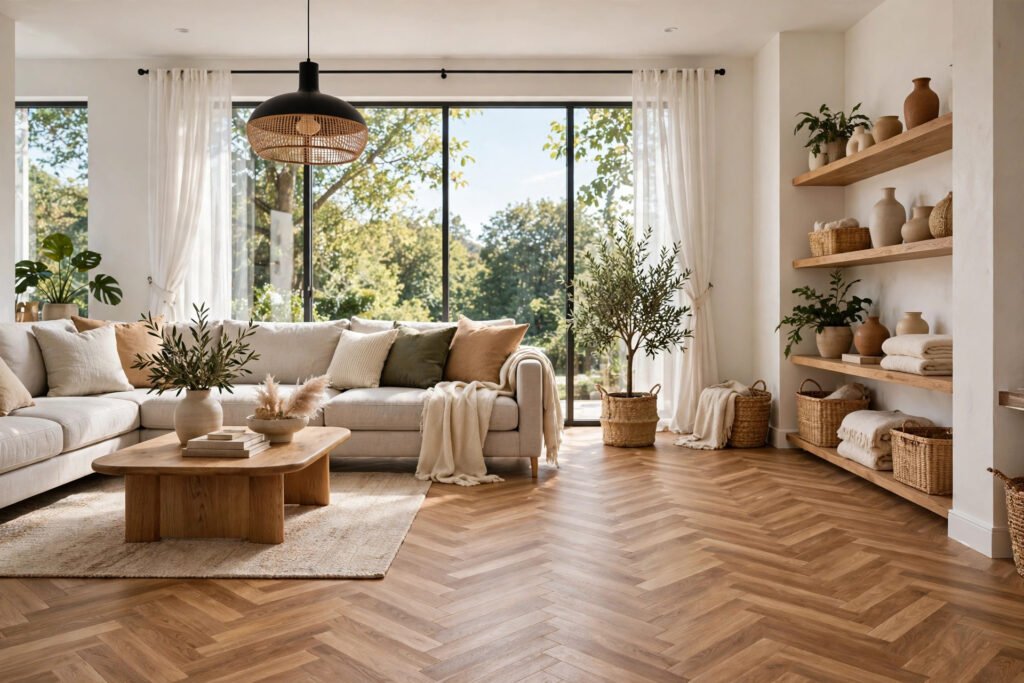
Herringbone has a way of making an ordinary room look considered. The zigzag pattern, borrowed from traditional parquet, catches the eye without shouting, and it suits everything from a Victorian hallway to a modern open-plan living space. The problem for many homeowners is that real parquet can be costly, slow to fit and demanding to maintain. That is where herringbone laminate flooring comes in: it recreates the look of timber parquet using manufactured planks, at a more accessible level of effort and upkeep.
This guide explains what herringbone laminate flooring actually is, how it is made, where it works well and where it does not, how to fit it, and how to look after it. It also sets out clearly how laminate differs from its closest lookalike, herringbone vinyl flooring, so you can choose the right material for your room rather than the one with the prettiest showroom sample.
What Is Herringbone Laminate Flooring?
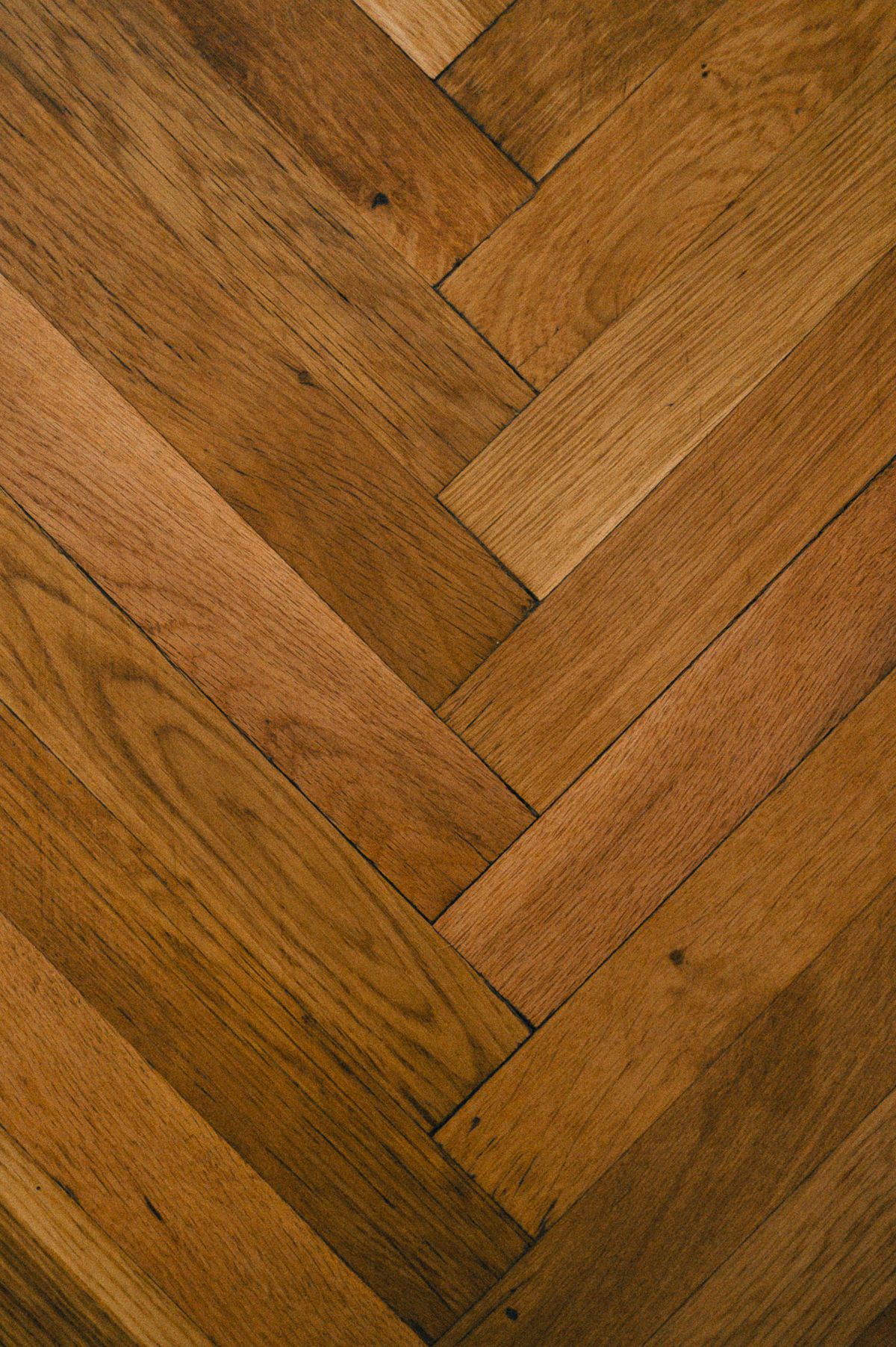
Herringbone laminate flooring is laminate flooring cut into rectangular planks and laid in the herringbone pattern, where each plank meets the next at a right angle to form a broken zigzag. Unlike straight-plank laminate, which runs in parallel rows, herringbone turns every joint into part of the design. The result is a floor with movement and texture, even in a single wood tone.
The pattern itself is not new. Herringbone parquet has been used in grand houses and apartments for centuries, prized for its sense of order and craftsmanship. Laminate versions bring that pattern within reach of a standard renovation budget and a standard DIY skill set, without the sanding, sealing and long drying times that solid timber parquet requires.
How Herringbone Laminate Flooring Is Made
Understanding the construction helps explain both the strengths and the limits of laminate. A typical herringbone laminate plank has four layers. The top wear layer is a tough, transparent melamine resin that resists scratches, stains and fading from sunlight. Beneath it sits a printed decorative layer, a high-resolution photograph of real wood, which gives the plank its oak, walnut or grey-washed appearance. The core is usually high-density fibreboard, or HDF, which gives the plank its rigidity and dimensional stability. At the bottom, a balancing layer keeps the plank flat and protects it from moisture rising from the subfloor.
Because the decorative layer is printed rather than real timber, manufacturers can reproduce consistent grain patterns, knots and colour variation across a whole floor. That consistency is a genuine advantage if you want a uniform look, though some homeowners prefer the natural variation of real wood. Plank thickness typically ranges from around 8mm to 12mm, and thicker planks tend to feel more solid underfoot and to sound quieter, especially when paired with good underlay.
Laminate vs Vinyl: The Key Difference in Construction
It is easy to confuse herringbone laminate with herringbone vinyl because they look similar once laid. The difference is in what sits under the surface. Laminate has a rigid fibreboard core, which makes it feel firm and wood-like underfoot, and gives it a crisp click when planks lock together. Vinyl flooring, by contrast, is made from layers of PVC, often with a stone or wood-plastic composite core, which makes it more flexible and inherently more resistant to water.
That construction difference drives almost every practical choice between the two. Laminate wins on the authentic, hard feel of a timber floor and on scratch resistance in dry living areas. Vinyl wins wherever water is a regular visitor, such as bathrooms, utility rooms and kitchens with frequent splashes. Neither is universally better; they are built for different jobs, and this guide focuses on where laminate is the right call.
Where Herringbone Laminate Flooring Works Best
Herringbone laminate is at its best in living rooms, bedrooms, hallways, dining rooms and home offices — the dry, everyday spaces where its wood look and hard-wearing surface shine. In a hallway, the zigzag pattern helps distract from scuffs and draws the eye along the space rather than across it. In a living room, it adds character without competing with furniture or artwork.
It is less suited to full bathrooms, wet rooms and rooms prone to standing water. Most laminate is water-resistant to splashes and spills that are wiped up promptly, but it is not waterproof. If water seeps into the joints and reaches the fibreboard core, planks can swell and the joints can lift. Some newer laminate ranges carry enhanced water-resistant ratings for kitchens and entrance areas, but even these need spills dealt with quickly and should not be laid where water pools regularly. If your room is a bathroom or a frequently wet utility space, vinyl is the safer material choice.
Underfloor heating is another room-by-room question. Many laminate products are compatible with water-based underfloor heating systems, provided the surface temperature stays within the manufacturer’s stated limit and the heating is brought up to temperature gradually. Electric mat systems need more careful checking, so always confirm compatibility for the specific product before ordering, rather than assuming all laminate behaves the same way.
Durability and Everyday Wear
Laminate is built for busy households. The wear layer resists scratches from pet claws, chair legs and children’s toys far better than a softwood floor, and it does not dent as easily as some real timbers. Wear ratings, often shown as an AC rating from AC3 for moderate residential use up to AC5 or AC6 for heavy commercial use, give a useful shorthand: for a family home, AC4 is a sensible middle ground, while a quiet spare bedroom can manage with less.
That said, laminate has a limit that real wood does not. A solid timber floor can be sanded and refinished when it is worn; laminate cannot. Once the wear layer is damaged through to the print, that plank needs replacing rather than repairing. The practical answer is to buy a few spare planks at the time of installation, keep them stored flat in a dry place, and choose a click system that allows a damaged plank to be lifted and swapped without dismantling half the room. Good door mats, felt pads under furniture feet and keeping grit off the floor with regular sweeping will extend the life of the surface far more than any aftercare product.
Preparing for Installation
Preparation decides whether a herringbone floor looks professional or amateur. The subfloor must be clean, dry, flat and stable. Old carpet, loose tiles and crumbling adhesive should be removed, and any dips or humps levelled, because laminate follows the shape of what is underneath it and will bounce or creak over uneven ground. A moisture check matters too, particularly over concrete, where a damp-proof membrane may be needed under the underlay.
Acclimatisation is often skipped and often regretted. Leave the sealed packs in the room where they will be laid for at least 48 hours so the planks adjust to the temperature and humidity of the space. Ripping out old flooring creates waste that cannot all go in a standard skip, so it is worth reading our guide to what you cannot put in a skip during a renovation before the old floor comes up, and planning disposal for adhesives, old underlay and any hazardous materials separately. Choosing the right tools also makes a visible difference; our guide to home improvement tools covers the saws, spacers and tapping blocks that turn a fiddly herringbone layout into a manageable weekend project.
Fitting Herringbone Laminate Flooring
Most herringbone laminate uses a click-lock system and is laid as a floating floor, meaning it is not glued or nailed to the subfloor but sits on underlay and is held in place by its own weight and the locked joints. An expansion gap around the perimeter, usually around 10mm and hidden by skirting or beading, allows the floor to expand and contract with seasonal changes in temperature and humidity.
The herringbone layout itself needs more planning than straight planks. Installers typically start from the centre of the room or from a focal wall and work outward, keeping the zigzag aligned so the pattern does not drift. Because each plank is shorter than a standard straight plank, there are more joints and more cuts, especially at walls and doorways, so waste allowance should be higher than for a straight-lay floor — allow generously rather than ordering exactly to the room area. A professional fitter is worth considering if the room has awkward angles, multiple doorways or a staircase junction, because a misaligned herringbone pattern is very hard to hide once the skirting goes back on.
Underlay choice affects comfort and noise. A good quality underlay with built-in moisture protection smooths minor subfloor imperfections, reduces footfall sound and adds a little insulation. In flats, check whether your lease or building rules require a specific acoustic underlay rating, since impact noise through a laminate floor can be a genuine neighbour issue.

Cost Factors Without the Guesswork
It is tempting to compare flooring purely on the price of a pack, but the true cost of a herringbone floor includes several other factors. Thicker planks and higher AC ratings tend to cost more but last longer in busy rooms. Herringbone layouts need a higher waste allowance than straight planks because of the extra cuts. Underlay, beading or new skirting, door thresholds and, if you hire a fitter, labour all add to the total. On the other hand, laminate avoids the sanding, sealing and long curing times of real parquet, which keeps both disruption and fitting time down.
When comparing quotes, ask what is included: underlay grade, waste allowance, removal of the old floor, skirting work and thresholds. A quote that looks cheaper because it omits these items is not a like-for-like comparison, and the extras often appear later as unexpected charges.
Caring for Herringbone Laminate Flooring
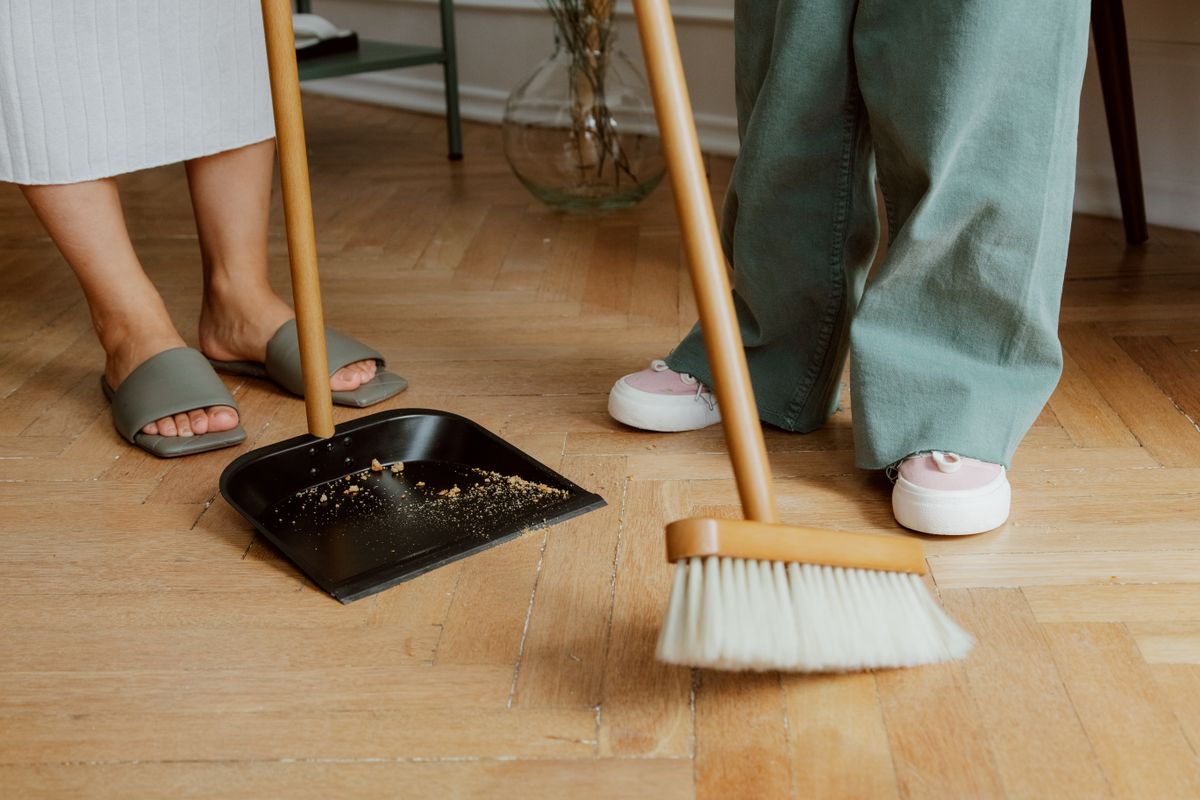
Day-to-day care is simple, which is part of laminate’s appeal. Sweep or vacuum regularly with a hard-floor setting to remove grit before it scratches the wear layer. Mop with a well-wrung damp mop rather than a wet one, and wipe up spills promptly, especially near exterior doors and in kitchens. Avoid steam mops, which can force moisture into the joints, and avoid abrasive cleaners or scouring pads that wear the surface.
For marks, a soft cloth with a laminate-safe cleaner usually suffices. Stubborn marks from shoes or furniture can often be lifted with a small amount of cleaner on a cloth rather than scrubbing the whole plank. Keep a few spare planks, as mentioned earlier, because replacing a single damaged plank is far easier than living with a visible chip in the middle of a herringbone pattern.
Common Mistakes to Avoid
- Skipping acclimatisation: Planks laid straight from a cold van or garage can expand later and lift at the joints.
- Laying over an uneven subfloor: Bounce, creaking and broken click joints usually trace back to preparation, not the product.
- Forgetting the expansion gap: A floor fitted tight to the walls has nowhere to expand and can peak in the middle.
- Using it in a wet room: Laminate handles splashes, not standing water — choose vinyl for genuinely wet spaces.
- Ordering too little: Herringbone needs more cuts and more waste allowance than straight planks.
- Wet mopping: Excess water is laminate’s main enemy; damp, never soaking, is the rule.
Frequently Asked Questions
Is herringbone laminate flooring suitable for kitchens?
It can work in a kitchen if spills are wiped up promptly and the product has a good water-resistance rating, but it is not the safest choice for a kitchen where water regularly reaches the floor. Vinyl is generally better for wet-prone kitchens and utility areas.
Can herringbone laminate be laid over underfloor heating?
Many products are compatible with water-based underfloor heating within a stated surface-temperature limit, but you must check the specific product’s guidance and bring the system up to temperature gradually. Not all laminate suits all heating systems.
Does herringbone laminate look like real wood?
Modern printed finishes are very convincing at normal viewing distance, with realistic grain and colour variation. Up close, the repeated pattern and the feel underfoot reveal that it is laminate rather than solid timber, but for most rooms that trade-off is well worth the lower maintenance.
How long does herringbone laminate flooring last?
In a typical home with normal care, a good quality laminate floor can last well over a decade, with busier rooms wearing faster than quiet ones. Its lifespan depends heavily on the wear rating, the quality of fitting and how promptly spills and grit are dealt with.
Can a damaged herringbone laminate plank be replaced?
Often yes, especially with a click-lock system, though replacing a plank in the middle of a herringbone pattern is more involved than swapping a straight plank at the edge of a room. Keeping spare planks from the original batch ensures the colour matches.
Conclusion
Herringbone laminate flooring offers the classic parquet look with the practicality of a modern manufactured floor: a hard-wearing surface, straightforward floating installation and simple daily care. It is at its best in dry living spaces, where its wood-effect finish and distinctive pattern can carry a room. Choose it for those spaces, prepare the subfloor properly, allow for the extra cuts a herringbone layout demands, and keep water away from the joints, and you will have a floor that looks far more expensive than the effort it took to lay. For rooms where water is a constant presence, look instead to herringbone vinyl, which trades a little of laminate’s firm timber feel for genuine water resistance.




More Stories
Herringbone Vinyl Flooring: A Complete UK Guide to Waterproof Styles, Fitting and Care