
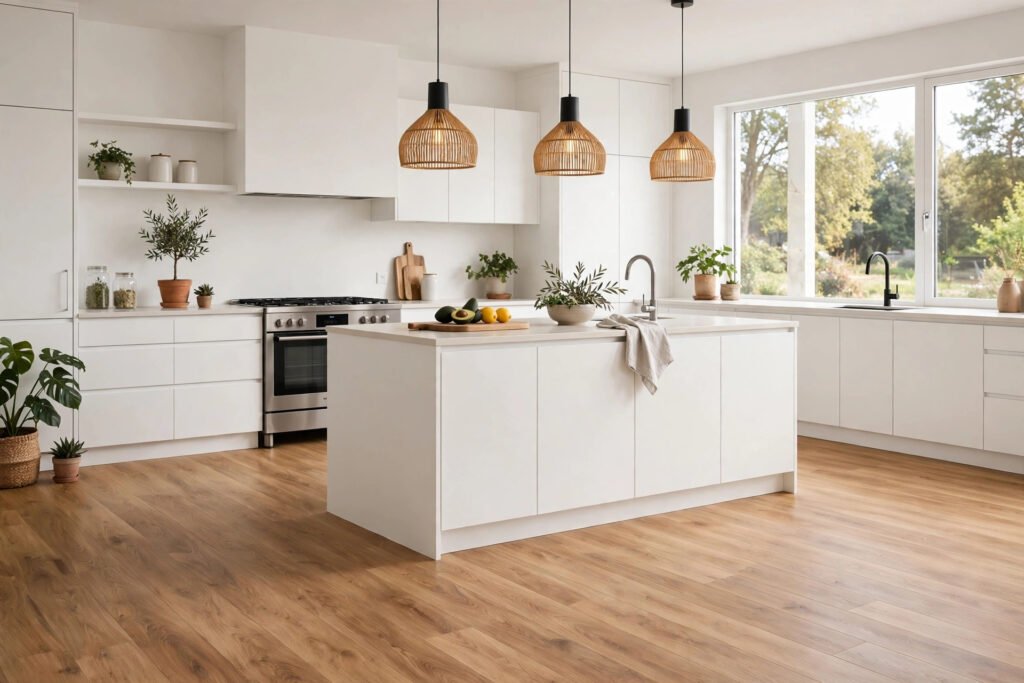
For years, the advice about laminate and water was simple: keep it dry. Standard laminate handles the odd splash, provided it is wiped up quickly, but its fibreboard core swells if water reaches it through the joints, so bathrooms, wet utility rooms and splash-prone kitchens were off limits. That advice still holds for standard laminate. What has changed is the product itself. A newer category, sold as waterproof or water-resistant laminate, is engineered to resist water far better than the laminate most homeowners know, and it deserves to be understood on its own terms rather than dismissed with the old rule or oversold as a miracle floor.
This guide explains what waterproof laminate flooring actually is, how it differs from standard laminate, where it can genuinely be used and where it still cannot, how to fit and care for it, and how to read manufacturers’ claims without being misled. It is a distinct product class, not a rebranding of ordinary laminate, and it sits in a useful middle ground: more water-resilient than standard laminate, with the firm timber feel laminate is known for, but still not a substitute for vinyl or tile in a full wet room.
What Is Waterproof Laminate Flooring?
Waterproof laminate flooring is laminate flooring designed to resist water penetration at the joints and into the core for far longer than standard laminate. It keeps the familiar laminate construction, a printed wood-effect decorative layer protected by a tough wear layer, over a rigid core, but every part of that construction is re-engineered for water resistance. The joints are sealed or treated to slow water entry, the core is made water-resistant rather than absorbent, and the edges and locking system are designed to keep the surface sealed when the floor is laid correctly.
The wording on packaging deserves care, because manufacturers do not all use the same terms in the same way. Some ranges are labelled waterproof, others water-resistant, and the difference often lies in how long the floor is tested against standing water and under what conditions. A floor tested against spills left for a limited period is not the same as a floor tested against prolonged immersion, and neither test describes a shower room. Treat the label as a starting point, then read the manufacturer’s own guidance for the exact range: how long water may sit on the surface, which rooms it is approved for, and what fitting details the warranty depends on. A claim is only as good as its conditions.
It helps to think of waterproof laminate as a spectrum rather than a switch. At one end sits standard laminate, which tolerates splashes wiped up promptly. In the middle sit enhanced water-resistant ranges, which cope with kitchen spills, wet paws and entrance-area drips with a much wider margin for error. At the far end sit fully waterproof-rated ranges, which are tested against standing water for extended periods and approved for kitchens and other splash-prone rooms. All of them are laminate, with laminate’s look, feel and fitting method, but they are not interchangeable, and buying the right point on that spectrum for your room is the first decision to get right.
How Waterproof Laminate Is Made
Three changes separate waterproof laminate from standard laminate, and they work together rather than alone. The first is the core. Where standard laminate uses a fibreboard core that absorbs water and swells, water-resistant laminate uses a core treated or manufactured to resist absorption, so water that does reach it causes far less swelling. Some ranges use a specially treated high-density fibreboard core, while others move further from traditional laminate construction altogether, but in every case the goal is the same: a core that does not behave like a sponge.
The second change is at the joints, which are the real entry point for water in any laminate floor. Waterproof ranges seal, coat or otherwise treat the edges of each plank, and their locking systems are designed to close tightly so that liquid sits on the surface rather than seeping between planks. Some ranges also require or recommend a joint sealant during fitting in the most exposed areas, such as around sinks and dishwashers, to close the last gaps. A floor is only as waterproof as its joints, so this detailing matters more than any single headline claim.
The third change is the surface and backing. The wear layer remains the same tough, transparent protection against scratches, stains and fading, but it is paired with edge and backing treatments that reduce moisture movement through the plank as a whole. Together, these changes mean that a spill which would threaten standard laminate within a short time can sit on waterproof laminate far longer without damage, giving a household a realistic margin for the spill that is noticed late, the dishwasher leak caught after an hour, or the wet dog that shakes off in the hallway before anyone reaches for a cloth.
How Waterproof Laminate Differs from Standard Laminate
The difference shows up most clearly in everyday accidents. On standard laminate, a spill must be wiped up promptly, because water at a joint begins working into the fibreboard core, and once a plank swells or a joint lifts, the damage is difficult to reverse. On waterproof laminate, that same spill is a housekeeping task rather than an emergency, because sealed joints and a resistant core buy time. That extra margin is the whole point of the category, and for busy family kitchens and hallways, it is a meaningful upgrade.
What does not change is just as important. Waterproof laminate still looks, feels and fits like laminate: a rigid plank with a printed wood surface, laid as a floating floor on underlay with an expansion gap around the perimeter, in straight or herringbone patterns. It still cannot be sanded and refinished like solid timber when the wear layer eventually wears, so spare planks from the original batch remain the sensible insurance. For the standard laminate baseline this category builds on, including its construction, wear ratings and pattern options, see Herringbone Laminate Flooring: A Complete UK Guide to Styles, Fitting and Care, which sets out how ordinary laminate is made and where it performs best.
One more distinction matters when comparing products: waterproof laminate is not vinyl, and it should not be judged as if it were. Vinyl has no fibreboard-derived core at all, so its water resistance comes from a fundamentally different construction. Waterproof laminate narrows the gap with vinyl in splash-prone rooms, and for many kitchens it closes it enough to be a genuine alternative, but it does so by resisting water better, not by becoming a different material. Understanding that distinction keeps expectations realistic and prevents the disappointment that comes from treating any laminate as if it were tile.
Where Waterproof Laminate Works Best
Waterproof laminate is at its best in kitchens, hallways, entrance areas, dining rooms and open-plan living spaces that flow into a kitchen. These are the rooms where standard laminate was always a compromise: dry enough most of the time, but exposed to the spill, the wet boot, the dripping umbrella and the pet bowl that standard laminate punishes. In a kitchen, waterproof laminate lets a household cook, wash up and mop without the constant anxiety that a single unnoticed splash will damage the floor. In a hallway, it copes with rain brought in from outside far better than ordinary laminate, and its firm, timber-like feel suits a space that sets the tone for the whole house.
It also suits family homes where the floor must survive children, pets and daily traffic while still looking like wood. The wear layer resists scratches from claws, toys and chair legs, and the water-resistant construction means muddy paws and spilled drinks are cleaning tasks rather than repair jobs. In rental properties and busy households, that combination of wood look, hard-wearing surface and water margin makes waterproof laminate a practical all-rounder for the rooms people actually live in, rather than a specialist product for a single room.
Underfloor heating follows the same rule as for standard laminate: many ranges are compatible with water-based systems within a stated surface-temperature limit, provided the heating is brought up gradually, but electric mat systems and individual products need checking. Always confirm compatibility for the exact range and system before ordering, rather than assuming that a waterproof rating implies a heating rating, because the two are tested separately.
Where Waterproof Laminate Cannot Go
The limits of waterproof laminate are as important as its strengths, and they are where overselling does the most damage. Full wet rooms, walk-in showers and rooms where water pools regularly and drains across the floor are still not suitable for any laminate, however it is rated. In those rooms, water does not arrive as a spill to be wiped up; it is the permanent condition of the floor, and it will find joints, edges, thresholds and wall junctions over time. Tile or a properly fitted vinyl floor remains the right choice there, and no laminate warranty changes that.
Bathrooms need a room-by-room judgement rather than a blanket yes or no. A bathroom with a separate shower enclosure, good ventilation and a floor that gets splashes rather than standing water may suit a fully waterproof-rated laminate, provided the manufacturer approves that use and the fitting seals every vulnerable edge. A small bathroom where the shower sprays across the floor, or a bathroom used by children who flood it regularly, is a different proposition, and vinyl or tile is the safer call. When in doubt, read the manufacturer’s room guidance for the exact range, and if it does not name bathrooms, do not assume it covers them.
Even in approved rooms, waterproof laminate is not a licence to ignore water. Leaks from appliances, plumbing failures and prolonged flooding will damage any laminate floor, and warranties invariably exclude them. The honest way to describe the category is that it turns accidents into manageable events, not that it makes water irrelevant. For the rooms where water is a constant presence rather than an occasional accident, our guide to Herringbone Vinyl Flooring: A Complete UK Guide to Waterproof Styles, Fitting and Care explains why vinyl, with no fibreboard core to swell, remains the materially safer choice.
Fitting Waterproof Laminate Flooring
Fitting waterproof laminate follows the familiar laminate method, with a few details that matter more than usual. The subfloor must be clean, dry, flat and stable, and the packs should be acclimatised in the room before laying, so the planks adjust to the temperature and humidity of the space. Most waterproof laminate uses a click-lock system and is laid as a floating floor on underlay, with an expansion gap around the perimeter hidden by skirting or beading, allowing the floor to expand and contract with seasonal change.
The waterproofing details deserve extra attention during fitting. Joints must be closed fully and firmly, without gaps where water could enter, and any joint sealant recommended by the manufacturer for splash zones should actually be used, particularly around sinks, dishwashers, washing machines and external doors. Underlay choice matters too: in kitchens and ground-floor rooms, an underlay with a moisture barrier adds a second line of defence beneath the floor, and over concrete a damp-proof membrane may be needed as well. Cutting corners on these details quietly voids the very protection the product was bought for.
Waste allowance follows the pattern, not the product: straight-lay floors need a modest allowance for cuts, while herringbone layouts need considerably more, because every plank is shorter and every wall and doorway generates offcuts. A professional fitter is worth considering for herringbone or for rooms with awkward angles, multiple doorways and fixed kitchen units, because a misaligned pattern or a poorly sealed joint is hard to hide once the skirting goes back on. As with any laminate, keep spare planks from the original batch, stored flat in a dry place, for future repairs.

Caring for Waterproof Laminate Flooring
Day-to-day care is simple, and waterproof laminate is more forgiving than standard laminate when cleaning routines slip. Sweep or vacuum regularly with a hard-floor setting to remove grit before it scratches the wear layer, then mop with a well-wrung damp mop and a laminate-safe cleaner. Unlike standard laminate, an occasional wetter mop or a spill left for a while is far less likely to cause damage, but damp rather than soaking remains the sensible rule, because the floor is water-resistant, not indestructible.
Spills should still be wiped up when noticed, both to keep the floor looking its best and to protect the joints over the long term. Avoid steam mops, which can force moisture into joints even on water-resistant ranges unless the manufacturer explicitly approves them, and avoid abrasive cleaners or scouring pads that wear the surface. For stubborn marks, a soft cloth with a laminate-safe cleaner is usually enough. Door mats at entrances, felt pads under furniture feet and prompt attention to appliance leaks do more for the floor’s lifespan than any aftercare product.
Watch the vulnerable points rather than the middle of the room. Edges around sinks, dishwashers, washing machines and external doors, and the junctions where the floor meets thresholds and skirting, are where water first finds a way in. Checking those areas occasionally, and resealing or repairing any lifted edge promptly, keeps a waterproof laminate floor performing as its rating promises for years rather than months.

Cost Factors to Consider
Waterproof laminate generally sits above standard laminate in cost, because the treated core, sealed joints and additional manufacturing steps all add to production, but the comparison should be made on total cost rather than pack price alone. The other factors are familiar from any laminate project: plank thickness and wear rating, underlay grade, waste allowance for the pattern, beading or skirting work, thresholds, removal of the old floor, and fitting labour if a professional is used. In splash-prone rooms, the higher pack cost is often offset by avoiding the early replacement a water-damaged standard laminate floor might need.
When comparing waterproof laminate with vinyl or tile for the same room, weigh the full picture. Tile may last longer in a genuinely wet room but costs more to fit and feels colder underfoot. Vinyl offers stronger water resistance but a different feel and, for glue-down types, a more demanding subfloor. Waterproof laminate offers the timber look and feel of laminate with a realistic water margin, at a fitting complexity most DIYers can manage. The right value judgement depends on the room’s actual water exposure, not on a single headline claim.
Common Mistakes to Avoid
- Assuming all waterproof claims are equal: Read the manufacturer’s test conditions and room approvals for the exact range before buying.
- Laying it in a full wet room: No laminate, however rated, suits rooms where water pools and drains across the floor.
- Leaving joints gappy: Waterproofing depends on tight joints, so close every plank fully and use recommended sealant in splash zones.
- Skipping the moisture barrier: Underlay and membrane protection matter most in kitchens and over concrete.
- Wet mopping as a habit: Damp cleaning is the rule even on water-resistant laminate; soaking is never good practice.
- Using a steam mop without checking: Sustained heat and moisture can defeat joint seals unless the manufacturer approves it.
- Ordering too little: Herringbone patterns in particular need a generous waste allowance for cuts.
Frequently Asked Questions
Is waterproof laminate flooring really waterproof?
It is far more water-resistant than standard laminate, thanks to sealed joints and a water-resistant core, but the honest answer depends on the exact range and its test conditions. It handles spills and splash-prone rooms with a wide margin, but it is not suitable for full wet rooms or prolonged flooding, and manufacturers’ room approvals should always be checked.
Can waterproof laminate flooring be used in a kitchen?
Yes, kitchens are one of its strongest use cases. Cooking splashes, dropped liquids and frequent mopping are exactly the conditions it is designed for, provided joints are sealed properly and appliance leaks are dealt with promptly rather than ignored.
Can waterproof laminate flooring be used in a bathroom?
It depends on the bathroom and the range. A well-ventilated bathroom with a separate shower enclosure and only occasional splashes may be approved by the manufacturer, but a wet room or a bathroom where water regularly reaches the floor is better served by vinyl or tile. Never assume bathroom approval; check the range’s own guidance.
How is waterproof laminate different from standard laminate?
Standard laminate has an absorbent fibreboard core and untreated joints, so water that reaches the core causes swelling. Waterproof laminate uses a water-resistant core with sealed or treated joints, giving spills a much longer safe window and making it suitable for kitchens and entrance areas where standard laminate would be a risk.
Conclusion
Waterproof laminate flooring is a genuinely useful new category, not a marketing trick and not a miracle. By sealing the joints and re-engineering the core, it gives laminate the water margin it always lacked, making kitchens, hallways and splash-prone living spaces realistic homes for a timber-look floor. It does not, however, erase laminate’s limits: full wet rooms remain out of bounds, fitting details still decide whether the rating holds in practice, and water ignored indefinitely will still cause damage. Buy the right point on the water-resistance spectrum for your room, read the manufacturer’s room approvals for the exact range, fit the joints tightly with the recommended sealing and moisture protection, and care for it with damp rather than soaking cleaning, and waterproof laminate will deliver what standard laminate promised but could not guarantee in a busy, splash-prone home.




More Stories
LVT Herringbone Flooring: A Complete UK Guide to Glue-Down Luxury Vinyl Tile
Herringbone Vinyl Flooring: A Complete UK Guide to Waterproof Styles, Fitting and Care
Herringbone Laminate Flooring: A Complete UK Guide to Styles, Fitting and Care