
Quick Takeaways
- Black laminate flooring gives a room a dramatic, modern look, and it changes how light and furniture read in the space.
- It works best in living rooms and bedrooms; think carefully before using it in wet rooms or very busy hallways.
- The advantages are style, price and easy care, while the drawbacks are that it shows dust, hair and scratches more clearly.
- Choose the finish, thickness and underlay for the room, and check the wear rating before you buy.
- Fit it on a flat, clean subfloor with underlay, leave an expansion gap, and replace a damaged plank rather than living with it.
What Is Black Laminate Flooring?
Black laminate flooring is laminate flooring finished in deep black or near-black tones, usually printed to imitate dark timber, stained oak, ebony or slate-like wood grain. Like all laminate, it is a manufactured plank: a tough transparent wear layer protects a printed decorative layer, which sits over a rigid core, usually high-density fibreboard, with a balancing layer underneath. The colour is the drama. Where pale oak laminate quietly recedes into a room, black laminate makes a statement, grounding the space and giving furniture, rugs and artwork a bold backdrop to sit against.
The range within black is wider than the name suggests. Some planks are a flat, matte jet black with minimal grain, which suits ultra-modern rooms and monochrome schemes. Others carry a visible wood grain in charcoal and espresso tones, with knots and colour variation that soften the darkness and read more like real stained timber. Grey-black and smoked finishes sit between the two, offering the grounding effect of black without quite the same contrast. Because the decorative layer is printed, manufacturers can reproduce these finishes consistently across a whole floor, which helps when a room needs a uniform, deliberate look.
It is worth understanding where black laminate sits among its neighbours before choosing it. The construction and fitting principles are shared with other laminates, so our guide to herringbone laminate flooring is a useful companion read on how laminate planks are made, how wear ratings work and how a pattern changes a room. Black laminate simply takes that familiar, practical product and gives it the boldest colour in the range.

The Look: Why Black Flooring Changes a Room
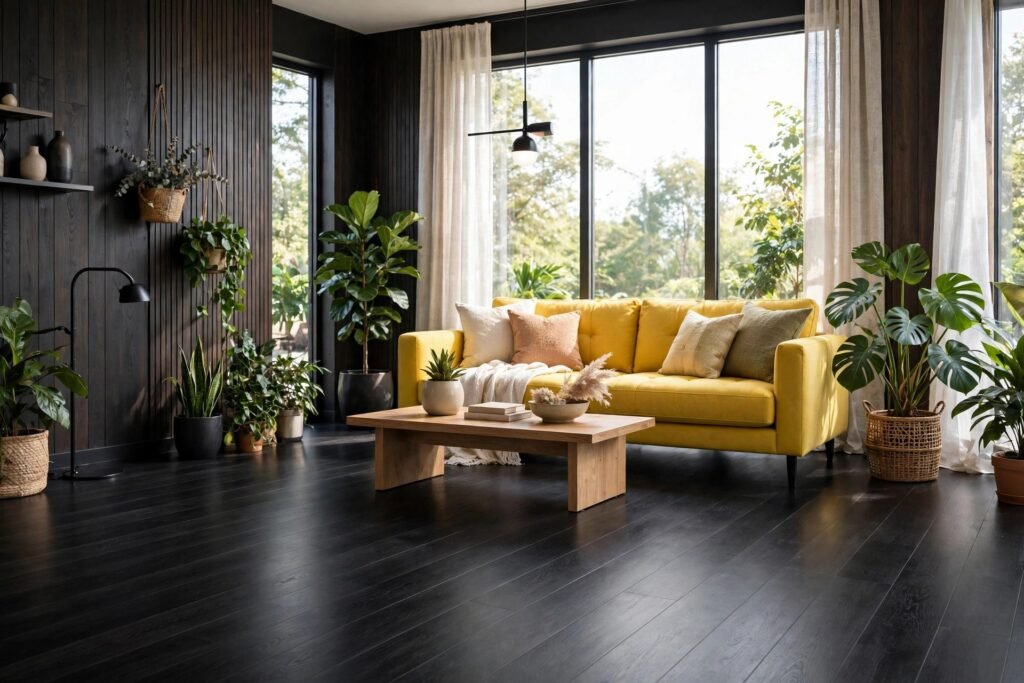
Black flooring changes the proportions of a room in a way lighter floors do not. Dark floors visually anchor a space, making walls appear taller and ceilings feel higher by contrast, and they give a room a sense of intention, as though every piece of furniture was chosen to sit on that dark stage. In open-plan living spaces, a continuous black floor can tie a kitchen, dining area and living zone together, giving the whole space a cohesive, gallery-like feel. In a single room, it creates a strong focal contrast that lets pale sofas, light wood and bright artwork stand out.
Light is the partner that decides whether black flooring succeeds. In a bright room with large windows, white or pale walls and good ceiling lighting, black laminate looks dramatic and sophisticated, and the contrast is the point. In a small, north-facing room with little natural light, the same floor can make the space feel darker and more enclosed, especially if the walls and furniture are also dark. The practical rule is balance: black floors love light walls, mirrors, pale rugs and bright textiles, and they reward rooms where daylight is generous.
Finish matters as much as colour. A matte black floor absorbs light and reads as soft and contemporary, hiding minor marks more forgivingly than a high-gloss surface. A glossier black laminate reflects light and furniture, which can make a room feel brighter and more polished, but it also shows dust, footprints and scratches more readily. Textured, wood-grain finishes sit in the middle, giving the floor visual interest at close range and helping everyday marks blend into the grain rather than standing out against a flat surface.
Best Rooms for Black Laminate Flooring
Black laminate is at its best in the dry, everyday living spaces where laminate generally shines: living rooms, bedrooms, hallways, dining rooms and home offices. In a living room, it gives a confident backdrop for a pale sofa, a light rug and colourful artwork. In a bedroom, paired with white bedding and warm wood, it can feel cocooning and hotel-like rather than stark. In a hallway, it hides the scuffs of daily traffic better than a pale floor in some lights, though it shows dust and light-coloured grit, so regular sweeping matters.
Kitchens deserve a more careful judgement. A kitchen is a splash-prone room, and standard laminate, whatever its colour, handles spills only when they are wiped up promptly, because water reaching the fibreboard core through the joints can cause swelling. If your heart is set on a dark floor in a kitchen, it is worth reading our guide to waterproof laminate flooring first, since water-resistant ranges give a much wider margin for the spill noticed late. For rooms where water is a constant presence rather than an occasional accident, such as full bathrooms and wet rooms, laminate of any colour is not the right material, and vinyl is the safer choice.
That vinyl alternative is worth knowing by name. Our guide to herringbone vinyl flooring explains how vinyl construction, with no fibreboard core to swell, copes with kitchens, bathrooms and utility rooms far better than laminate, while still offering dark wood-effect finishes. If the room you have in mind is genuinely wet, a dark vinyl may give you the black-floor look with the water resistance the room actually needs.
Pros and Cons of Black Laminate Flooring
The advantages start with the look and continue into practicality. Black laminate delivers a high-end, dramatic appearance at laminate’s usual level of effort and upkeep, and it pairs with almost any wall colour, from crisp white to deep green, because black is a neutral. The wear layer resists scratches from pet claws, chair legs and children’s toys better than a softwood floor, and it does not dent as easily as some real timbers. Dark wood-grain finishes are also forgiving of the small marks of family life, since grain and variation disguise minor scuffs that would stand out on a plain pale floor.
The disadvantages are mostly about visibility and light. Dust, light hair, pet fur and pale grit show up clearly on a black floor, so it needs sweeping or vacuuming more often than a mid-tone floor if it is to look its best. Scratches that cut through the wear layer to the print underneath are also more noticeable on black than on a variegated mid-brown, which is why felt pads under furniture feet and good door mats matter even more here. And unlike solid timber, laminate cannot be sanded and refinished when it is worn, so a damaged plank needs replacing rather than repairing, which makes keeping spare planks from the original batch a sensible habit.
There is also the light question, which is really a room question. Black laminate suits bright rooms and balanced schemes, and it can overwhelm a small, dark room or a scheme where everything else is already dark. If you love the look but worry about a particular room, try large samples in that room first, viewed in both daylight and evening light, with your actual furniture and rug in place. A sample viewed in a showroom tells you far less than a sample viewed on your own floor.
Choosing the Right Black Laminate
Start with the finish and grain. A flat matte black suits minimalist and monochrome rooms, while a dark wood-grain plank suits rooms where you want warmth as well as drama, and a grey-black smoked finish suits industrial and Scandinavian-inspired schemes. Then check the practical specifications: plank thickness, which typically ranges from thinner boards to thicker, more solid-feeling ones, and the wear rating, often shown as an AC rating, where a mid-to-high residential rating is a sensible choice for a family home and a quiet spare bedroom can manage with less.
Consider the plank format too. Straight planks laid in parallel rows give a calm, contemporary floor that lets the colour do the work, while a patterned layout adds movement and texture. If a pattern appeals to you, our guide to LVT herringbone flooring explains the herringbone pattern in depth, albeit in vinyl, and the same visual logic applies: the zigzag catches the eye and distracts from scuffs, which can be a real advantage on a dark floor. Whichever format you choose, order generously, keep spares, and check that the underlay suits your subfloor and any acoustic requirements in a flat.
Underfloor heating is a room-by-room check, not an assumption. Many laminate products are compatible with water-based underfloor heating within a stated surface-temperature limit, provided the heating is brought up to temperature gradually, but electric mat systems need more careful checking. Always confirm compatibility for the specific product before ordering, rather than assuming all laminate behaves the same way.
Fitting Black Laminate Flooring
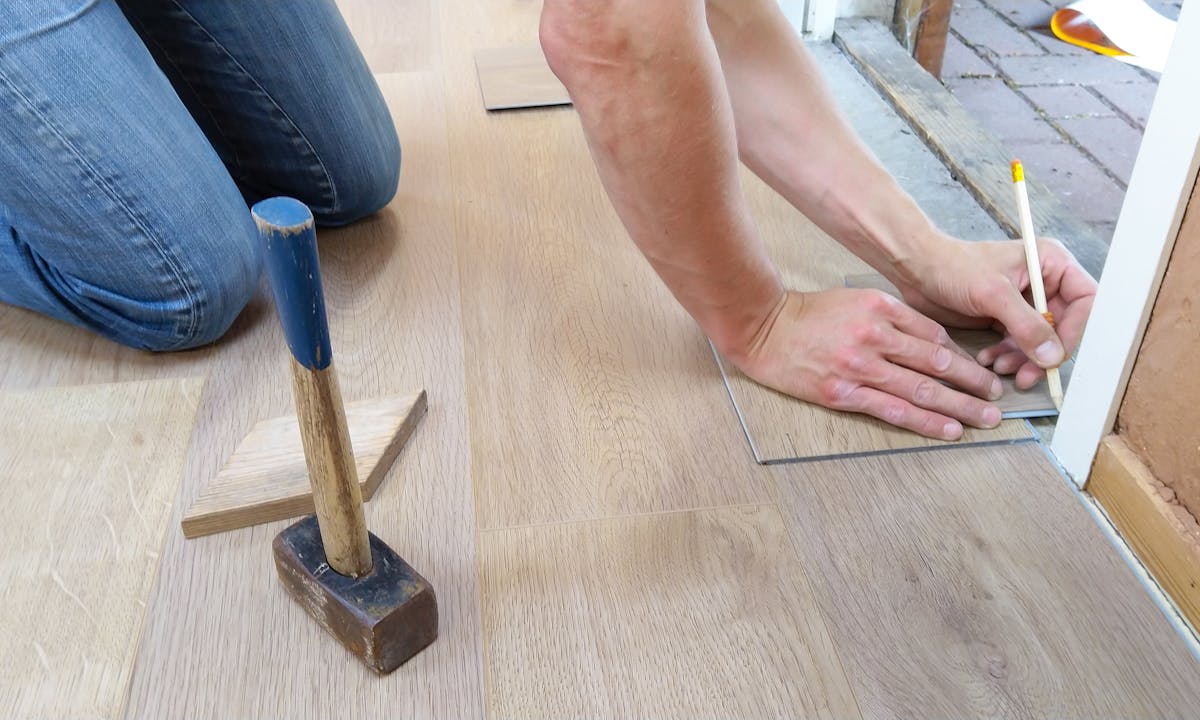
Fitting black laminate follows the familiar laminate method, and preparation decides whether the result looks professional. The subfloor must be clean, dry, flat and stable, because laminate follows the shape of what is underneath it and will bounce or creak over uneven ground. Old carpet, loose tiles and crumbling adhesive should be removed, dips and humps levelled, and moisture checked, particularly over concrete, where a damp-proof membrane may be needed under the underlay. Packs should be left sealed in the room where they will be laid so the planks adjust to the temperature and humidity of the space before fitting.
Most laminate uses a click-lock system and is laid as a floating floor, sitting on underlay rather than glued or nailed to the subfloor, with an expansion gap around the perimeter, hidden by skirting or beading, to allow for seasonal movement. Dark floors show gaps and misaligned joints more readily than pale ones, so take extra care with the first rows, which set the alignment for the whole room, and stagger the joints in a pleasing, random pattern rather than lining them up. A professional fitter is worth considering if the room has awkward angles, multiple doorways or a staircase junction, because a misaligned pattern is very hard to hide once the skirting goes back on.
Underlay choice affects comfort and noise. A good quality underlay with built-in moisture protection smooths minor subfloor imperfections, reduces footfall sound and adds a little insulation. In flats, check whether your lease or building rules require a specific acoustic underlay rating, since impact noise through a laminate floor can be a genuine neighbour issue, and a dark floor does nothing to soften that conversation.
Caring for Black Laminate Flooring
Day-to-day care is simple, which is part of laminate’s appeal, but black floors reward a slightly more regular routine. Sweep or vacuum frequently with a hard-floor setting to remove grit before it scratches the wear layer, and to keep dust and light debris from dulling the dark surface. Mop with a well-wrung damp mop rather than a wet one, using a laminate-safe cleaner, and wipe up spills promptly, especially near exterior doors and in kitchens. Avoid steam mops, which can force moisture into the joints, and avoid abrasive cleaners or scouring pads that wear the surface.
For marks, a soft cloth with a laminate-safe cleaner usually suffices, applied to the mark rather than scrubbed across the whole plank. Keep a few spare planks, as mentioned earlier, because replacing a single damaged plank is far easier than living with a visible chip in the middle of a dark floor. Good door mats, felt pads under furniture feet and keeping grit out of the house will extend the life of the surface far more than any aftercare product.
Styling helps maintenance too. A pale or patterned rug in the seating area breaks up the dark expanse, catches dust before it spreads, and gives the room a layered look, while light curtains and mirrors bounce daylight around and stop the floor from dominating a smaller room. Think of the black floor as the frame, not the whole picture, and let the furniture and textiles provide the contrast that makes it sing.
Common Mistakes to Avoid
- Choosing black for a dark, small room without testing samples: View large samples in your own room, in daylight and evening light, before committing.
- Skipping acclimatisation: Planks laid straight from a cold van or garage can expand later and lift at the joints.
- Laying over an uneven subfloor: Bounce, creaking and broken click joints usually trace back to preparation, not the product.
- Forgetting the expansion gap: A floor fitted tight to the walls has nowhere to expand and can peak in the middle.
- Using it in a wet room: Laminate handles splashes, not standing water, so choose vinyl for genuinely wet spaces.
- Ordering too little: Allow generously for cuts, and keep spare planks from the original batch for repairs.
- Wet mopping: Excess water is laminate’s main enemy, so damp, never soaking, is the rule.
Frequently Asked Questions
Does black laminate flooring make a room look smaller?
It can make a small, dark room feel more enclosed, but in a bright room with pale walls it often does the opposite, grounding the space and making the walls appear taller by contrast. Balance is everything: light walls, mirrors and pale textiles keep a black floor dramatic rather than oppressive.
Does black laminate show dust and scratches more?
Dust, light hair and pale grit do show more readily on black than on mid-tone floors, so regular sweeping matters. Scratches through the wear layer are also more visible, which is why felt pads, door mats and a wood-grain finish that disguises minor marks are all worth considering.
Is black laminate flooring suitable for kitchens?
It can work in a kitchen if spills are wiped up promptly and the product has a good water-resistance rating, but it is not the safest choice for a kitchen where water regularly reaches the floor. Water-resistant laminate or vinyl is generally better for wet-prone kitchens and utility areas.
Can black laminate be laid over underfloor heating?
Many products are compatible with water-based underfloor heating within a stated surface-temperature limit, but you must check the specific product’s guidance and bring the system up to temperature gradually. Not all laminate suits all heating systems.
Can a damaged black laminate plank be replaced?
Often yes, especially with a click-lock system, though replacing a plank in the middle of a floor is more involved than swapping one at the edge of a room. Keeping spare planks from the original batch ensures the colour matches.

Conclusion
Black laminate flooring offers drama, versatility and the practicality of a modern manufactured floor: a hard-wearing surface, straightforward floating installation and simple daily care. It is at its best in bright rooms with balanced schemes, where its dark ground lets light walls, pale furniture and artwork shine. Choose the finish that suits your room, test large samples in your own light, prepare the subfloor properly, keep water away from the joints, and sweep a little more often than you would for a pale floor, and you will have a floor that looks far more expensive than the effort it took to lay. For rooms where water is a constant presence, look instead to dark vinyl, which trades a little of laminate’s firm timber feel for genuine water resistance.
Share Your Thoughts
Would you choose black laminate flooring for your home, and in which room? Tell us in the comments what convinced you, or what put you off. If this guide helped, please share it with someone planning new flooring.




More Stories
Laminate and Underlay: A Complete UK Guide to Types, Fitting, Sound, Warmth and Durability
Waterproof Flooring: A Complete UK Guide to Types, Rooms and Care
Cushion Flooring: A Complete UK Guide to Soft, Comfortable Floors